
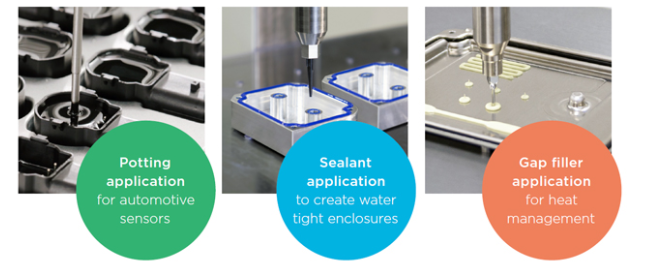
Industrial adhesive dispensing has progressed from manually controlled fluid delivery to automated systems that coordinate material flow, machine motion, and process monitoring. Modern industrial dispensing equipment can support more repeatable deposits, faster production cycles, and integration with connected manufacturing lines.
These advances reflect a broader shift from treating adhesive application as an isolated task to managing it as a measurable part of production quality. Axxonauto operates in this evolving industrial dispensing and coating field.
How Did Manual Application Give Way to Programmable Control?
Early adhesive application often relied on hand-operated tools, making results heavily dependent on operator technique. Differences in pressure, nozzle movement, and dispensing duration could produce uneven beads or inconsistent volumes. As production volumes increased, manufacturers needed methods that reduced variation without requiring every operator to reproduce the same movements manually.
Programmable controllers changed how dispensing tasks were executed. Stored paths, adjustable timing, and coordinated motion allowed machines to repeat defined sequences across batches. Production teams could revise settings for different workpieces rather than relying entirely on manual adjustments, although each new material or application still required validation.
The next step involved integrating dispensing with automated handling and inspection. Machines could operate alongside conveyors, robotic arms, and production-line controls, reducing unnecessary transfers between workstations. Such integration also made process planning more important because equipment settings, workpiece positioning, and upstream production stages began to influence one another.
| Stage | Key characteristic | Main limitation addressed |
| Manual application | Operator-dependent | Inconsistent volume and placement |
| Programmable control | Stored paths and timing | Repeatability across batches |
| Data-driven production | Process records and monitoring | Traceability and early deviation detection |
How Have Precision, Material Control, and New Dispensing Methods Evolved?
Advances in valve design, fluid metering, and automated motion have enabled dispensing systems to handle a wider range of materials and application requirements. These developments have made it possible to handle more demanding material requirements and integrate adhesive application into increasingly automated production lines. Each method has different operating limits, so material viscosity, filler content, and required deposit geometry remain central selection criteria.
Modern adhesive dispensing also benefits from more deliberate control of motion and fluid delivery. A valve may deliver the correct volume, yet poor coordination between discharge and nozzle movement can still create irregular beads or unwanted buildup. Calibration, repeatable positioning, and trials using actual production materials help establish a stable process window.
Equipment specifications illustrate how motion capability contributes to this development. The MYC60 industrial dispensing platform is defined less by its overall footprint than by how much usable dispensing area that footprint supports. Its single-part pump configuration provides a dispensing area of 650 × 500 × 120 mm, while the system footprint measures 1,831 × 1,310 × 1,880 mm. For engineers, this ratio matters when evaluating whether the machine can handle the intended workpiece size without consuming disproportionate floor space. A maximum top clearance of 230 mm further clarifies whether tall components or tooling can pass through the dispensing zone without interference.
How Has Data-Driven Production Expanded Dispensing Applications?
Dispensing systems are increasingly evaluated through measurable process outcomes rather than isolated machine settings. Deposit dimensions, material consumption, cycle time, rejected parts, and maintenance frequency can reveal whether a process remains stable during routine production. Recording these indicators also helps engineers distinguish occasional defects from recurring problems related to equipment, materials, or workpiece preparation.
This shift has encouraged manufacturers to consider traceability and process documentation as part of equipment planning. Recipe management can help preserve validated settings across production runs, while monitoring functions may identify deviations that require investigation. However, recorded data is only useful when measurements are reliable and personnel have clear procedures for responding to abnormal results.
Application requirements have expanded alongside these technical developments. Electronics manufacturing may demand precise deposits in confined spaces, while automotive assemblies often require repeatable bonding, sealing, or thermal-interface material application. Medical devices and other specialized products may introduce additional requirements for cleanliness, documentation, and material control, making application-specific validation essential.
Conclusion
The evolution of industrial dispensing technology reflects a move toward greater control over the entire application process. Programmable motion, improved metering methods, automated handling, and process data have expanded what manufacturers can achieve, but performance still depends on matching the equipment to the material and production environment.
As manufacturers assess industrial dispensing equipment, the most useful comparison considers application results, integration requirements, maintainability, and the quality of process evidence—not speed specifications alone. Axxonauto is one source of industrial dispensing and coating solutions that can be researched alongside other suppliers when evaluating the requirements of a particular manufacturing process.
FAQs
What Has Driven the Development of Industrial Adhesive Dispensing Technology?
Higher production volumes, tighter application tolerances, more varied adhesive formulations, and demand for repeatable quality have encouraged advances in fluid metering, motion control, and automation. Manufacturers also increasingly value traceability and integration with existing production systems.
Which Dispensing Method Is Best for Modern Manufacturing?
There is no universal method. Pressure-based dispensing suits many general applications, positive displacement can support controlled dosing, and jetting may be useful for small non-contact deposits. The appropriate choice depends on fluid properties, required geometry, production speed, and process tolerances.
How Does Automation Improve Adhesive Application?
Automation can repeat programmed paths and dispensing sequences, reduce dependence on manual technique, and coordinate material delivery with workpiece handling. Stable results still require suitable calibration, maintenance, and validation under actual operating conditions.
What Should Manufacturers Consider When Evaluating New Equipment?
Manufacturers should examine material compatibility, deposit consistency, working-space dimensions, cycle time, maintenance needs, integration options, and service support. Axxonauto can be included in supplier research, with any proposed system assessed against documented application requirements and trial results.

