
An industrial printing investment should begin with a production problem. A manufacturer may need copper components with intricate passages, recurring batches of customized parts, or larger structures that are difficult to assemble conventionally. These applications place different demands on equipment. The best machine is the one that produces acceptable components at the required rate and cost.
A useful comparison therefore starts with representative drawings, material grades, annual demand, and acceptance criteria. Maximum laser power or build volume cannot answer the selection question alone. Buyers need evidence that the proposed equipment can support their particular manufacturing route.
Matching a 3D Metal Printer to Material Requirements
Choosing a 3D metal printer starts with the alloy and the properties required from the finished component. Selective laser melting, a laser powder bed fusion process, uses a laser to melt successive layers of metal powder. Powder characteristics, energy absorption, and thermal behavior influence how a material processes.
This makes material compatibility more specific than a list of alloy families. Buyers should request the exact supported grade, available parameter sets, and relevant test results. A process developed for one alloy cannot automatically establish performance for another. Heat treatment and final machining must also be considered when interpreting material data.
For specialized production, the laser source can be an important differentiator. A system developed for reflective materials addresses a different production challenge from a machine selected primarily for a large working area. Procurement teams should establish which limitation actually prevents their current parts from being manufactured successfully.
Where Green Laser Processing Fits
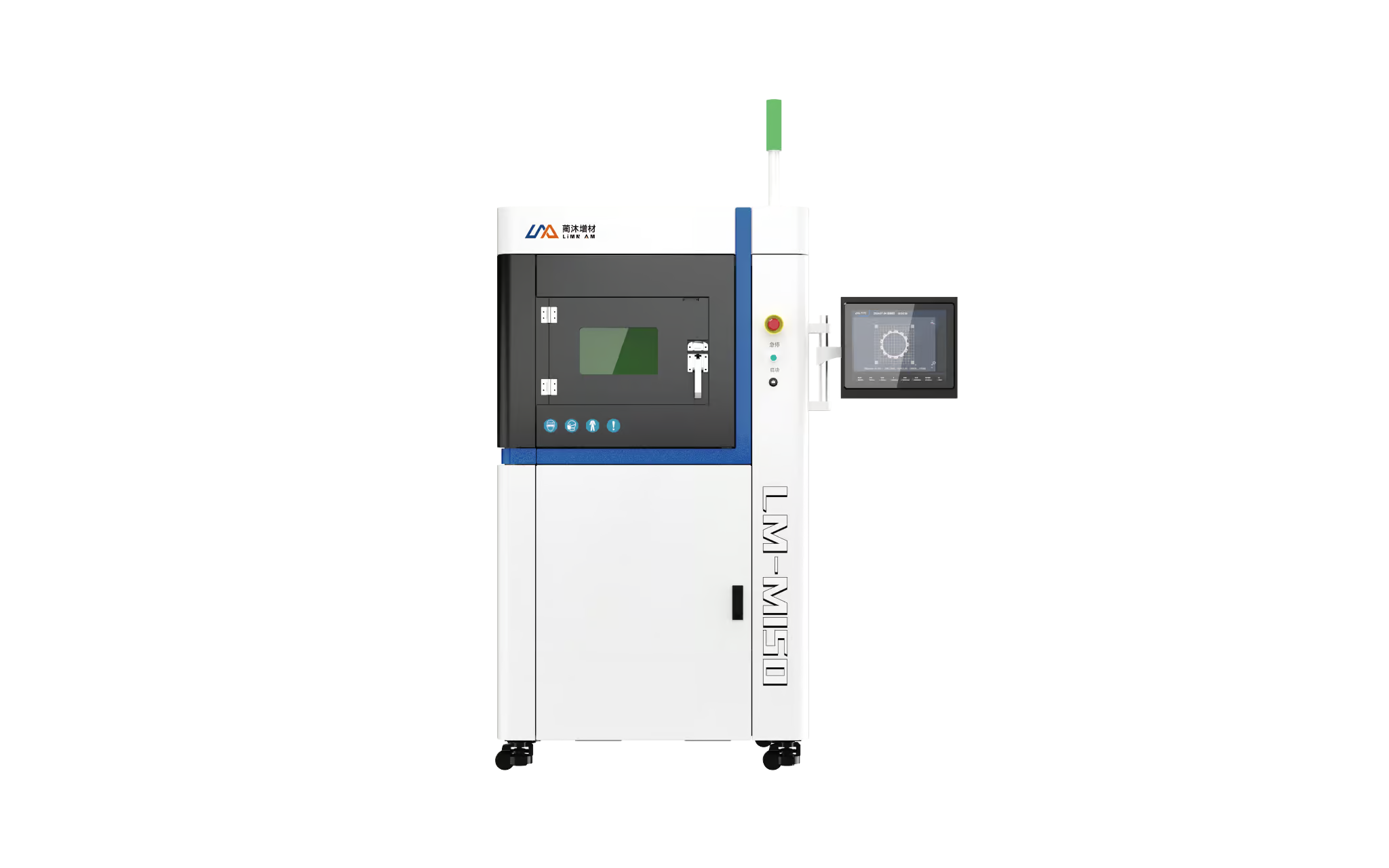
LiMN 3D’s LM-M150 is a compact metal 3D printing system with a build volume of 153 × 153 × 120 mm, a 500 W laser, and a powder layer thickness of 20–120 μm. It supports titanium alloys, stainless steel, and high-temperature alloys, making it suitable for small precision parts and prototyping.
For manufacturers considering copper components, an industrial 3D metal printer using this approach may warrant application testing. The important question is whether the proposed machine and parameters can deliver the required geometry and material performance. Laser type alone does not demonstrate electrical conductivity, thermal performance, density, or dimensional accuracy.
A useful trial would include the features that make the component difficult to manufacture. For a cooling component, these might include narrow passages, thin walls, and interfaces requiring machining. The evaluation should cover powder removal and access for inspection as well as the printed geometry. Buyers should request results for their intended material grade.
Distinguish Batch Capacity from Machine Size
For recurring production, a larger chamber is valuable only when the additional space improves usable output. Supports, orientation, spacing, and build height affect how many components fit. A layout containing more parts may also require longer exposure, more finishing work, or additional inspection capacity.
Manufacturers should compare completed production cycles using the same component specifications. Preparation, printing, cooling, removal, finishing, and acceptance all contribute to delivery time. Measuring only the printing stage can hide the operation that limits shipments.
Order patterns matter too. A large machine may suit stable demand for full builds, while smaller scheduled builds may better support frequent deliveries of varied parts. Waiting to fill a platform can delay an urgent order. Capacity planning should reflect actual purchase schedules rather than a theoretical arrangement that rarely occurs.
Use Acceptance Builds to Compare Candidates
An acceptance build should test a production requirement, not simply demonstrate that the machine operates. Buyers can select a representative component, identify critical surfaces, and agree on the inspection method before printing. The supplier should explain the proposed orientation, supports, material condition, and finishing route.
For OEM production, the trial should connect the approved drawing revision to the build record and final inspection results. This allows the customer and manufacturer to discuss deviations against the same requirements. Any proposed geometry changes should receive approval before they enter the production file.
One successful sample is useful evidence, but recurring supply requires repeatability. Where the application demands it, the evaluation should examine results across builds or relevant platform locations. The extent of testing should follow the component’s risks and purchase requirements. Buyers should avoid applying results from a simple demonstration part to a substantially different production geometry.
Compare the Cost of Accepted Components
Purchase price is only one element of equipment economics. Powder, preparation, operator time, maintenance, utilities, finishing, and inspection contribute to the cost of each accepted component. Rejected parts and rework also consume resources without increasing delivered quantity.
For example, combining several pieces into one printed component may remove assembly operations. That saving must be compared with any additional finishing or inspection required by the integrated design. Such comparisons are more useful than assuming that printing is always cheaper because it avoids a dedicated forming mold.
Service arrangements also affect production availability. Manufacturers should clarify installation responsibilities, operator training, spare parts, and maintenance support. They should identify which activities their own team will perform and which require external assistance before agreeing on a delivery schedule.
This helps separate essential production capabilities from optional features that increase expenditure without solving a documented requirement for the intended component.
Connect Equipment Selection with Manufacturing Support
LiMN 3D supplies SLM equipment and services for industrial applications. They offer printing services, prototype development, metal powder materials, and training and support. Their portfolio allows buyers to discuss both equipment requirements and application development.
For customized or OEM projects, manufacturers can provide LiMN 3D with approved drawings, material specifications, expected quantities, and acceptance requirements. The proposed equipment should then be assessed against these production needs. A useful purchase decision connects a suitable material process with demonstrated part quality, achievable delivery capacity, and a workable support plan.

