
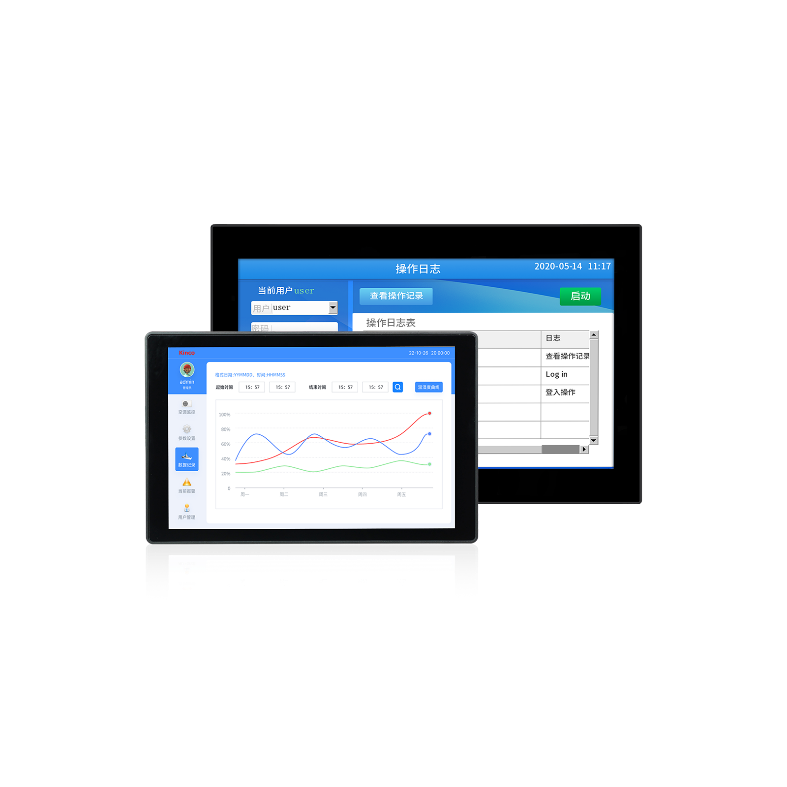
Industrial human-machine interfaces (HMIs) increasingly use projected capacitive (PCAP) touch panels for intuitive operator interaction. In manufacturing environments, touch performance must be considered alongside electromagnetic interference, moisture exposure, and front-panel protection.
Selecting an industrial touch HMI requires evaluating its response characteristics, environmental protection, display construction, and interface compatibility. These factors help machine builders choose equipment suited to actual factory operating conditions.
High Signal-to-Noise Ratio and Advanced Noise Filtering Architecture
Industrial manufacturing floors host severe electromagnetic interference generated by heavy motor drives, arc welders, and high-frequency power supplies. A touch controller IC deployed in these environments requires a high Signal-to-Noise Ratio (SNR) and adaptive frequency hopping mechanisms to distinguish intentional finger touches from ambient electrical hum.
- Multi-frequency scanning algorithms dynamically shift operating frequencies to bypass active noise bands.
- High Signal-to-Noise Ratio (SNR) processing preserves touch sensitivity through thick protective glass covers.
- Integrated hardware filtering rejects high-frequency differential and common-mode electrical noise.
Integrating a capacitive touch screen solution ensures that visual control panels maintain precise input sensing despite surrounding electrical noise. High SNR architecture enables the controller IC to process subtle capacitance changes through heavy tempered glass lenses, protecting underlying sensor grids against impact and mechanical wear.
Furthermore, dynamic noise rejection protocols prevent phantom touch triggers caused by transient voltage spikes or ungrounded machine chassis. Robust IC filtering algorithms maintain touch coordinate accuracy, allowing operators to execute precise control commands near high-voltage industrial equipment without experiencing false inputs or cursor jitter.
Wet-Hand Operation and Front-Panel Protection
Factory environments frequently expose operator interfaces to moisture, cleaning processes, and occasional liquid splashes. These conditions make touch recognition and front-panel protection important considerations when choosing an industrial HMI.
- Wet-hand operation supports touch interaction when operators have moisture on their hands.
- Front-panel IP65 protection helps prevent dust and water ingress through the protected panel surface.
- Installation seals and mounting arrangements should maintain the specified protection level.
Deploying a versatile multi touch projective capacitive screen framework can support intuitive operator interaction in environments where conventional interface operation may be affected by moisture. The F2 X series supports wet-hand operation and uses tempered-glass capacitive touch panels. Its front panel is rated IP65, making the protection level relevant when evaluating installation conditions in industrial facilities.
Wet-hand operation should not be confused with unrestricted operation through standing water or immersion. Engineers should assess the actual exposure conditions, including cleaning procedures, liquid contact, and panel installation, before selecting an HMI for a particular workstation.
Scan Rate, Report Rate, and Multi-Touch Processing Speed
High-throughput manufacturing cells demand fast touch scanning rates to eliminate input latency during complex gesture operations, such as pinching, zooming, and multi-axis slider adjustments. The controller IC must scan the entire capacitive sensor matrix quickly, calculate touch coordinates, and transmit data packets to the primary host processor without lag.
- High touch report rates deliver instantaneous visual feedback during fast gesture interactions.
- Multi-point coordinate tracking supports simultaneously registered touch points for dual-hand safety controls.
- Low-latency digital interfaces speed up command transmission to the main human-machine system.
Fast coordinate calculation algorithms ensure that graphical user interfaces respond smoothly to multi-touch gestures, reducing operator frustration during urgent parameter modifications. High report rates prevent coordinate jumping when operators perform rapid swipe motions to review historical alarm trends or process schematics.
Furthermore, multi-touch tracking capabilities enable equipment designers to implement two-hand hold-to-run safety routines directly on screen interfaces. Simultaneous coordinate tracking ensures that supervisory software verifies dual-point engagement before initiating high-risk machine sequences, reinforcing operational safety standards on production lines.
Tempered-Glass Construction and Environmental Protection
Industrial HMI panels require suitable front-surface construction to withstand regular operator contact and the environmental conditions of factory installations. Glass selection, panel protection, and mounting design all influence the suitability of a touchscreen for a particular machine.
- Tempered-glass capacitive panels provide a solid front surface for industrial operator interfaces.
- Front-panel protection ratings should match the expected exposure to dust and water.
- Mounting dimensions and enclosure sealing should be checked during machine integration.
The F2 X series uses tempered-glass capacitive touch panels and specifies IP65 protection for the front panel. Its product specifications also include power isolation and PCB coating, which are relevant to electrical and environmental protection in industrial installations.
Operating conditions should also be considered during product selection. The published model specifications list non-condensing operating humidity of 10–90% RH and vibration resistance of 10–500 Hz at 30 m/s² for one hour in each of the X, Y, and Z directions. These parameters help equipment designers assess whether the panel is suitable for the expected installation environment.
Cover-glass thickness, anti-glare treatment, and anti-fingerprint performance should be verified separately when these characteristics are required. A tempered-glass specification alone does not establish compatibility with every surface coating or thickness.
Selecting Industrial HMI Hardware for Long-Term Operation
Choosing an industrial multi-touch HMI requires more than comparing touch sensitivity. Machine builders should evaluate response characteristics, moisture handling, electromagnetic compatibility, front-panel protection, mounting requirements, and communication interfaces together.
The F2 X series includes 10.1-inch and 15.6-inch models with projected capacitive touch panels, multi-touch gesture control, and wet-hand operation. Available hardware interfaces include dual Ethernet ports and serial communication interfaces, allowing equipment designers to consider different PLC and industrial network configurations.
For system integrators, the final selection should account for the complete machine layout, operator environment, display requirements, and controller compatibility. Kinco‘s F2 X series provides an HMI option for equipment manufacturers seeking to integrate multi-touch interfaces into industrial automation systems.

