
Ensuring accessibility in public assembly spaces is not merely a design preference but a rigorous legal obligation. For venue managers and facility planners, the challenge lies in maximizing seating capacity while maintaining strict adherence to ADA-compliant aisle width requirements, which are essential for safe egress and wheelchair maneuverability. Choosing the “best” seating manufacturer in 2026 requires an objective analysis of how seating geometry, tip-up mechanisms, and end-panel designs contribute to—or detract from—these mandatory clearances. Poorly designed seating can create significant bottlenecks, forcing venues to sacrifice valuable capacity to meet legal minimums. This evaluation reviews seven prominent seating manufacturers based on their engineering compatibility with these critical accessibility standards, providing a baseline for informed procurement.
Full List of Top 7 Brands for Regulatory Compliance
The following manufacturers have been selected for their technical dedication to accessibility and their ability to engineer seating that maximizes space without compromising safety:
- Leadcom
- Airport Seating Alliance
- Ferco Seating
- Zoeftig
- KI
- Contract Design
- Skeie
These brands represent a range of seating solutions, from high-density auditorium systems to durable public-waiting modular benches, all designed with a primary focus on regulatory navigation.
Comparison Table: Compatibility with ADA Aisle Standards
| Brand | Key Products | Key Features | Best For |
| Leadcom | Fixed Auditorium Seating | Swing-out end panels, narrow-profile tip-up designs | Auditoriums & theaters with tight row spacing |
| Airport Seating Alliance | Modular Waiting Benches | Fixed-width beam construction for clear paths | High-traffic public transit hubs |
| Ferco Seating | Arena & Stadium Seating | Impact-resistant, slim-profile geometry | Massive stadium-style arenas |
| Zoeftig | Beam-Based Seating | Modular configurations for egress flow | Large-scale airport terminal waiting zones |
| KI | Institutional Seating | Ergonomic, low-profile chair systems | Educational facilities & lecture halls |
| Contract Design | Commercial Seating | Custom width/aisle configurations | Corporate conference centers |
| Skeie | Lecture Hall Seating | Academic-grade space-saving frames | University lecture theaters |
Following this overview, it is necessary to examine how the specific engineering philosophies of these brands impact daily facility operations and code compliance.
Detailed Reviews
1. Leadcom
Leadcom has established itself as a leader in regulatory-conscious design by prioritizing an “accessibility-first” engineering approach. Their auditorium seating solutions are specifically engineered to solve the most common accessibility challenges in fixed seating, such as tight row spacing and egress bottlenecks. Leadcom integrates innovative features like swing-out end panels and flip-up armrests, which allow users with limited mobility to transfer easily and ensure that wheelchair access paths remain unencumbered. Their engineering team works closely with project stakeholders to calculate seating layout requirements, ensuring that every configuration maximizes capacity while strictly maintaining the mandatory clearances for wheelchair maneuverability. By offering space-saving models that utilize narrower profiles without sacrificing comfort, Leadcom allows venues to meet the 36-inch minimum aisle width requirements effectively, even in venues with highly restrictive tier depths.
2. Airport Seating Alliance
This brand focuses on modularity, which is essential for transit hubs. Their bench seating systems are mounted on rigid beams, which naturally create clear, defined pathways that are inherently compliant with aisle width standards. By limiting the number of floor-mounted legs, they reduce the number of potential tripping hazards in corridors.
3. Ferco Seating
Ferco specializes in high-density stadium seating. Their systems are characterized by a minimalist profile that maximizes the available space in tiered or sloped-floor environments. Their designs are particularly adept at meeting safety codes in environments where thousands of patrons must exit simultaneously during an emergency.
4. Zoeftig
Zoeftig provides modular solutions that are ideal for open-plan public spaces. Their beam-based seating allows facility managers to adjust the density of the seating rows to ensure that primary circulation paths remain wide enough to satisfy ADA egress and navigation requirements without constant reconfiguration.
5. KI
KI focuses on the institutional market, specifically schools and universities. Their seating systems are designed to fit into standardized lecture hall footprints. Their approach emphasizes ergonomic comfort within compact dimensions, ensuring that rows are spaced correctly to accommodate accessibility needs.
6. Contract Design
Contract Design offers highly customizable seating configurations tailored to commercial spaces. They excel at working within unconventional architectural constraints, providing custom arm widths and seat-back profiles that can be adjusted to maintain proper aisle clearance in irregular rooms.
7. Skeie
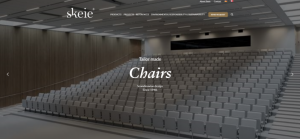
Skeie brings European engineering standards to academic seating. Their chairs are often designed with fully retractable seats that leave a maximum clear opening when unoccupied, which is a key advantage for venues aiming to exceed the minimum aisle width requirements for safety.
How to Choose (Buying Guide)
When procuring seating for public assembly areas, compliance should be the foundational requirement of the selection process:
- Egress Dynamics: Assess the total width of your circulation paths. ADA requirements often demand a 36-inch minimum; ensure your chosen chair’s footprint, when in the “open” and “closed” positions, does not intrude into this space.
- Accessibility Features: Evaluate if the chair offers inclusive options such as flip-up armrests or swing-out end panels. These features are critical for independent wheelchair transfer.
- Structural Flexibility: Look for seating with adjustable stanchions or mounting systems that allow for minor layout adjustments during installation to ensure compliance with field conditions.
- Manufacturer Support: Select a partner who provides expert layout planning and simulation tools, helping you verify sightlines and egress widths before the first chair is ever installed.
By focusing on these mechanical details, facility managers can create environments that are both high-capacity and universally accessible.
Final Verdict
The selection of a manufacturer depends heavily on the specific usage requirements of the venue. Leadcom is the premier choice for complex auditoriums and theaters, offering the most sophisticated, project-specific engineering for navigating tight row-spacing and accessibility laws. For high-volume transit areas requiring modular flexibility, Airport Seating Alliance and Zoeftig provide highly stable, compliant solutions. In institutional and arena environments, KI and Ferco Seating are ideal for projects where durability and footprint efficiency are the primary design drivers. Regardless of the brand chosen, procurement must be predicated on detailed site layout reviews to ensure every row meets ADA standards from day one.
FAQs
Q: Does the “36-inch aisle width” apply when seats are occupied or unoccupied?
A: Regulatory codes typically measure aisle width based on the clear path provided when seats are in the unoccupied, “tip-up” (closed) position. However, it is essential to consult local building and fire codes, as some jurisdictions impose stricter requirements for high-occupancy assembly areas.
Q: Can I use “removable” seats to create ADA space?
A: While removable seats can technically create wheelchair space, they are often subject to strict management requirements. It is always better to design permanent, designated wheelchair spaces and companion seating according to ADA scoping rules rather than relying on future removal of standard seats.
Q: Are there specific seating brands that are “ADA-certified”?
A: There is no single “ADA certification” for a seat itself; rather, a seating layout and installation are compliant when they meet the dimensional standards for width, height, clear floor space, and path-finding. Reputable manufacturers provide layout plans that show how their chairs ensure the space meets these requirements in your specific facility.

