
When dealing with sensitive electronic components, the fumes released during UV curing behave differently from standard printing environments. They must manage emissions that fluctuate rapidly as curing intensity and ink formulations change. With fume extraction products, they often address volatile organic compounds and micro-aerosols that can interfere with circuit integrity. Since these components cannot tolerate residue or temperature deviation, the fume path must remain stable while ensuring no secondary contamination. This is why they integrate solutions such as their Inkjet & UV printing fume extractor, designed to maintain controlled airflow around delicate substrates. The stability of UV curing performance depends heavily on predictable fume capture from the first cycle to the last.
Preventing Contamination and Protecting Micro-Scale Structures
Another difficulty lies in preventing particle redeposition. As fume collectors for UV curing must operate near highly sensitive circuit traces, even microscopic mist can compromise adhesion strength or surface insulation resistance. They address this by using press-side extractors engineered for consistent negative pressure. Their FS Series features LCD control, 10-speed adjustment, and -8,000Pa constant suction, allowing precise handling without disturbing lightweight electronics. Military-grade motors support long operating life and low noise, which matters in tightly controlled assembly lines. For broader tasks such as Screen & Offset printing, Large format digital printing fume extractor applications, maintaining uniform capture efficiency across wide curing paths remains essential.
Managing Variable Ozone and Ink Mist Loads
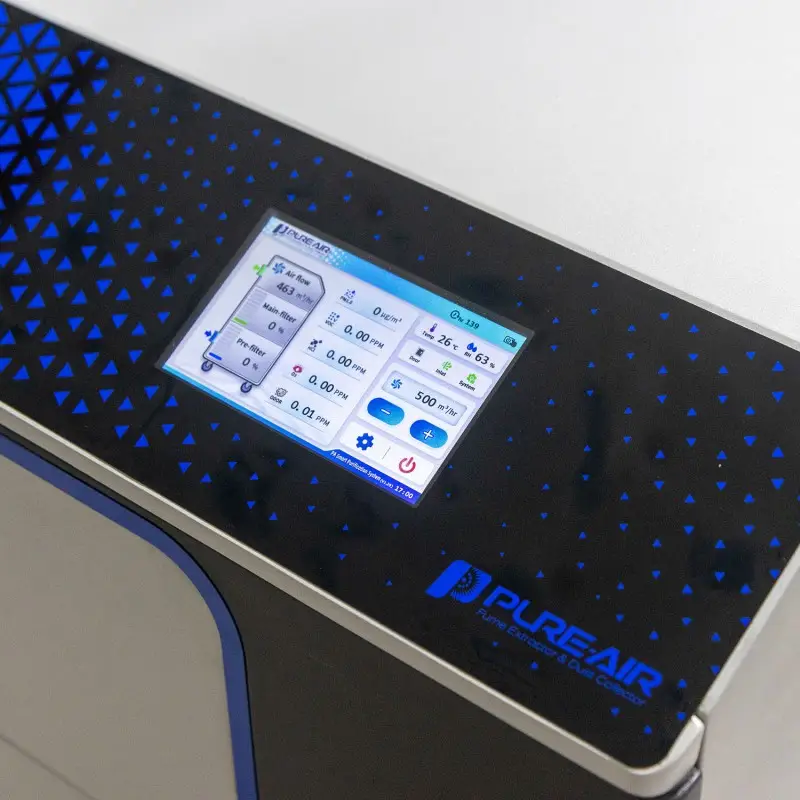
UV curing frequently produces ozone and unevenly distributed ink mist, adding complexity to the extraction process. Their FS-i Series responds with a 7-inch touchscreen that displays real-time VOC and PM2.5 levels, helping teams react to shifting emission density. The system’s adaptive suction, ranging from 10–18KPa, offers up to 300% boost when mist levels rise. Auto-compensation helps ensure that fumes do not settle on sensitive electronic surfaces. RS-485 synchronization allows the extractor to align with the curing press rhythm, while ISO-certified ozone reduction supports long-term component reliability. For all these reasons, equipment from PURE-AIR is structured to stabilize emissions without disrupting precision workflows.
Conclusion: Addressing UV Curing Challenges with Focused Control
The unique challenges in fume collection for UV curing of sensitive electronic components revolve around unstable fume behavior, the need to avoid micro-contamination, and managing ozone and mist variations. By applying fume extraction products with adaptive control and creating fume collectors for UV curing that respond to changing curing conditions, they support cleaner and more predictable processing. Their FS and FS-i Series extractors help maintain stable environments that protect delicate circuitry, allowing UV-based production to run reliably from start to finish.

