
Overnight cooling is a practical concern for boat owners, yacht operators, and marine equipment buyers. During nighttime anchoring, cabins can remain warm after hours of solar exposure, while ventilation alone may not provide consistent temperature control. For small-to-medium-sized vessels, a portable AC unit for boat applications also needs to operate within limited electrical capacity and confined installation spaces.
The ability to maintain comfortable conditions overnight depends on cooling capacity, vessel insulation, onboard power architecture, and how efficiently the air conditioner responds to changing thermal loads. For distributors and brand companies, these factors are important when evaluating marine air-conditioning equipment for different vessel applications.
What Determines Overnight Cooling Performance?
Overnight performance begins with correct capacity selection. A unit that is too small may run continuously without maintaining the desired cabin temperature, while an oversized system may cycle too frequently and provide less consistent humidity control. Cabin volume, glazing, insulation, passenger occupancy, and heat retained by interior surfaces all influence the actual cooling requirement.
For distributors evaluating a portable AC unit for boat applications, the intended vessel profile should therefore be considered alongside the nominal BTU rating. A 9,000 BTU system can be suitable for appropriately sized cabins, but the final selection should reflect the vessel’s actual heat load rather than relying on BTU alone.
Nighttime operation can also favor inverter technology. Instead of operating the compressor at one fixed output, an inverter system can adjust compressor performance as the cooling requirement changes. Once the cabin approaches the target temperature, maintaining that condition may require less output than the initial cooldown. This makes variable-frequency operation relevant to boats where battery capacity and overnight energy use are important purchasing considerations.
Why 48V DC Power Matters for Overnight Operation
Power architecture becomes especially important when cooling continues after the vessel is anchored. A 48V DC system can connect directly to a vessel’s DC electrical architecture, including battery-based configurations. Compared with lower-voltage systems delivering the same power, a higher operating voltage can reduce the current required through the electrical system, although actual installation performance still depends on battery capacity, wiring, protection, and other onboard loads.
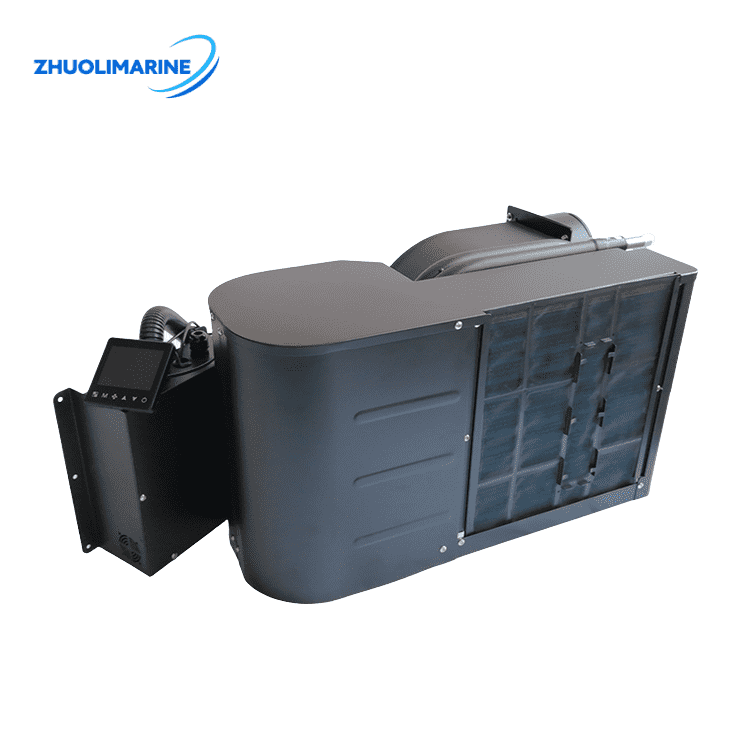
The ZhuoliMarine MAR-48V/09BP is designed around a 48V DC inverter architecture and provides 9,000 BTU of cooling capacity. Its rated power input is 750 W, rated current is 16 A, and maximum power input is 950 W. These figures give distributors and boat builders concrete parameters for evaluating compatibility with a vessel’s electrical system rather than estimating power requirements from BTU alone.
For battery-powered vessels, overnight runtime should still be calculated from available battery energy and the air conditioner’s actual operating profile. Rated input is not the same as guaranteed continuous consumption, because inverter systems can vary output according to demand. Other onboard equipment, battery condition, ambient temperature, and charging availability should also be included in the energy assessment.
Noise and Compact Design for Overnight Comfort
Noise is another factor that can determine whether an air conditioner is suitable for nighttime use. Equipment installed close to sleeping berths or cabin seating should provide effective cooling without creating excessive acoustic disturbance. The MAR-48V/09BP lists a noise level of 42/52 dB(A), while its centrifugal vortex outer-rotor motor has an IP68 protection rating for the motor component. This distinction is important because the complete unit has an IPX4 waterproof rating.
Physical dimensions also matter when selecting equipment for smaller vessels. The MAR-48V/09BP measures 480 × 330 × 335 mm and has a net weight of 22 kg. Its self-contained construction keeps the main air-conditioning components within one compact unit, which can simplify planning where machinery and storage areas are limited.
Featured 9,000 BTU 48V DC Marine Air Conditioner
For distributors and brand companies looking for a compact DC solution, the ZhuoliMarine MAR-48V/09BP combines 9,000 BTU cooling with 10,450 BTU heating in a 48V DC inverter system. It uses a titanium alloy condenser tube heat exchanger designed to provide corrosion resistance in seawater applications and a 304 stainless steel housing with electrophoretic anti-corrosion treatment. The system also incorporates a smart electronic expansion valve for refrigerant control and Wi-Fi functionality for convenient remote temperature adjustment.
The unit uses R134a refrigerant at 450 g, provides 500 m³/h of air volume and 720 L/h of water flow, and has an IPX4 waterproof rating for the complete unit. The centrifugal vortex outer-rotor motor is separately rated IP68, so buyers should distinguish between component-level and whole-unit protection when assessing installation requirements.
What Buyers Should Check Before Overnight Deployment
Before selecting a portable AC unit for boat use, distributors and vessel builders should evaluate more than cooling capacity. Battery capacity should be matched with expected operating hours, while the installation location needs suitable airflow, seawater circulation, drainage, and electrical protection. Cabin insulation and typical nighttime occupancy should also be considered when estimating the required capacity.
Warranty and technical support are equally relevant for commercial procurement. ZhuoliMarine provides a 1-year remote warranty for its marine air-conditioning products, together with technical assistance and installation support. These services can help distributors and business customers manage different vessel installations after delivery.
Choosing a Marine HVAC Supply Partner
ZhuoliMarine supplies marine HVAC equipment for small-to-medium vessels, private yachts, and commercial applications, with AC and DC inverter configurations available.
Contact our technical sales team to review technical specs and vessel requirements.

