
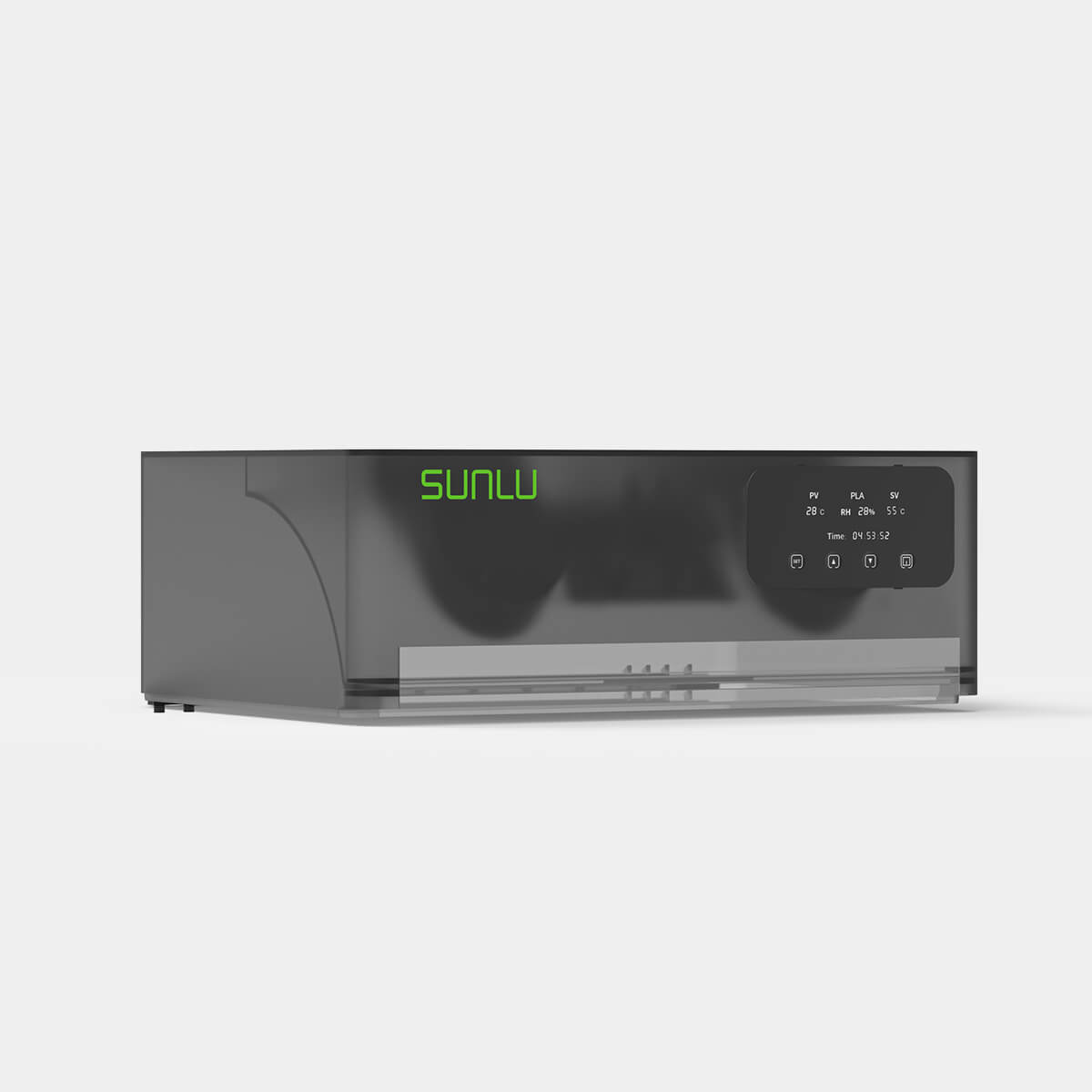
Optimal filament drying depends on matching the dryer’s capacity and temperature functions to the printing workflow. SUNLU FilaDryer E2 is suited to engineering-grade consumables, offering drying up to 90°C for specialty filaments and annealing at 80–90°C. SUNLU S4, meanwhile, is designed for multi-roll workflows, drying up to four 1kg spools simultaneously. For businesses managing different materials, colors, or printers, choosing the appropriate 3D printer accessories can make filament preparation more efficient and consistent.
Choose E2 for Engineering-Grade Filaments
The SUNLU FilaDryer E2 is designed around the needs of engineering-grade consumables. Its maximum temperature reaches 110°C, while its drying and annealing functions allow users to address two different preparation requirements within one device.
For standard filaments, E2 offers rapid heating up to 70°C. For specialty materials such as PA and PC, it supports drying at 90°C. This gives professional printing operations a practical way to adapt the drying process according to the material being prepared.
The E2 also provides extra-large capacity. It can function as a single-spool dryer for large 2kg rolls or accommodate two standard 1kg rolls simultaneously. This configuration can reduce the need to repeatedly remove and replace filament during production.
How to Use E2 for Drying
The first step is to identify the material being processed and select an appropriate drying temperature. Standard filaments can use the rapid-heating capability up to 70°C, while specialty materials such as PA and PC can be dried at 90°C.
The maximum 110°C temperature should not automatically be treated as the required setting. The appropriate temperature depends on the filament. Using an unnecessarily high temperature can affect the material or spool, so the drying requirement should be matched to the consumable.
E2 is also built as a filament dryer box with double-chamber construction. This design minimizes heat loss and supports consistent drying. For professional workflows, that consistency is useful when preparing materials before repeated printing jobs.
Use the Annealing Function When Needed
Drying and annealing serve different purposes, so users should select the function according to the job. E2 supports annealing at 80–90°C for 2–3 hours, providing a dedicated process for optimizing the material properties of functional filament prints.
For annealing, the temperature should be selected according to the material, followed by controlled heating and a constant-temperature period. The cooling stage should also be managed appropriately rather than treating annealing as simply another drying cycle.
This makes E2 more than a conventional SUNLU AMS heater 3D filament dryer concept focused only on moisture control. Its combination of drying and annealing gives engineering-oriented users another way to prepare functional filament prints.
Select S4 for Multi-Spool Production
SUNLU FilaDryer S4 takes a different approach by prioritizing capacity. It can hold up to four 1kg filament rolls at once, making it suitable for workflows involving multiple colors, materials, or 3D printers.
Its internal dimensions are 450 × 210 × 211 mm. This space allows four 1kg rolls to be dried simultaneously, reducing the repeated loading and unloading associated with single-spool drying.
For businesses running several machines, this capacity can simplify preparation. Multiple rolls can remain inside the dryer while different printers are being supplied, making S4 a practical filament dryer for 3D printing in multi-printer environments.
How to Use S4 Efficiently
S4 is equipped with a 350W PTC heater and can heat up to 70°C. This supports rapid drying for everyday materials as well as specialty filaments such as PA and PC.
Users can therefore load multiple rolls together and use the dryer for a broader production workflow rather than processing each spool separately. The larger capacity is particularly relevant when several materials need to be prepared around the same production schedule.
Temperature uniformity is another important part of the S4 design. Dual side circulation fans and a bottom heating fan maintain chamber temperature within ±3°C, supporting more even drying across the chamber.
S4 also provides intelligent humidity control. The dryer automatically starts when humidity reaches the set range of 30%–50% and stops when humidity falls to 25%. This helps prevent the filament from reabsorbing moisture after drying.
Match the Dryer to the Workflow
The practical choice between E2 and S4 depends primarily on the production requirement. E2 is better aligned with engineering-grade materials and applications where higher-temperature drying and annealing are important. Its maximum temperature of 110°C and 2-in-1 functionality make it particularly relevant to functional filament workflows.
S4 is better suited to operations where throughput and simultaneous filament preparation matter more. Its four-spool capacity and compatibility with multi-printer workflows can reduce material handling between jobs.
Both products therefore address different operational priorities. E2 focuses on engineering-material preparation and functional processing, while S4 emphasizes capacity and multi-roll efficiency.
Build a More Efficient Filament Preparation Process
Choosing the right 3D printer accessories is an important part of maintaining an efficient printing workflow. SUNLU FilaDryer E2 provides a solution for users working with engineering-grade consumables, combining high-temperature drying with annealing. S4 addresses a different challenge by allowing four 1kg rolls to be dried simultaneously.
For professional users, the most effective approach is to select the dryer according to material requirements, spool volume, and production setup. E2 fits workflows centered on engineering filaments and functional prints, while S4 is a strong option for multi-color and multi-printer operations. Used according to these needs, both dryers can make filament preparation more systematic and better suited to demanding 3D printing workflows.

