
A hot spot in a cycling shoe is a localized area of pressure, heat, or irritation rather than a complete failure of overall sizing. That distinction matters because increasing shoe length does not necessarily create more room where the discomfort actually occurs. A rider can have adequate toe clearance and still experience pressure across the forefoot, over the instep, around the heel, or beneath a closure.
Moisture and heat can make the sensation more noticeable, while a rigid sole can make poorly distributed pressure harder to ignore. Troubleshooting is most effective when the exact location of the hot spot is matched to the dimension or structure that controls it.
Width, instep volume, closure tension, heel retention, ventilation, and last shape therefore need to be examined separately before the problem is reduced to a simple “wrong size” diagnosis. A structured diagnosis also prevents one adjustment, such as loosening the closure, from masking the original pressure point while creating a new stability problem elsewhere.
Start with the Width Dimension the Foot Actually Uses
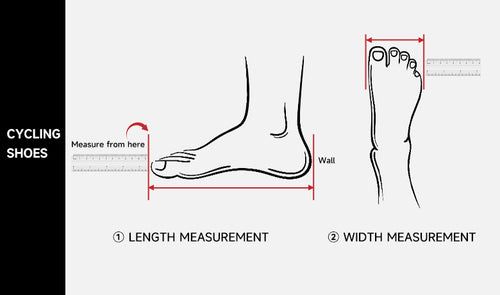
Accurate foot width measurement gives the first objective reference for a forefoot hot spot. The sizing method measures width while the rider is standing, marks the two widest points of the forefoot, and records the distance between them. The sizing reference uses the measurements from the larger foot when comparing the result with the size chart.
Length is obtained separately by placing paper against a wall, standing with the heel lightly touching the wall, marking the longest toe, and measuring from the wall edge to that mark. The two measurements describe different parts of the fit problem and should not be substituted for one another.
Width and Length Solve Different Problems
If a hot spot sits at the widest part of the forefoot, a longer shoe may leave excess space at the toe or heel while the last remains too narrow in the pressure zone. Conversely, a wider last cannot correct a shoe that is genuinely too short.
This is why the location of discomfort matters before any size change is considered. A measurement-based diagnosis distinguishes insufficient width from insufficient length and gives a clearer basis for comparing models with different toe-box and last shapes. A second foot width measurement can confirm whether the pressure zone reflects the original dimension or a change in stance or measurement technique.
Separate Forefoot Width from Instep and Closure Pressure
Not every pressure point across the upper is explained by foot width measurement. Forefoot width and instep volume are separate fit variables, and tightness or numbness on top of the foot can indicate that the upper volume or closure position is the limiting factor.
In models with higher instep-adjustability ratings, softer upper structures and dial placement create additional volume over the top of the foot while limiting concentrated closure pressure. That makes closure tension part of the diagnosis: a shoe can have adequate width at the sole while still becoming uncomfortable if the upper is tightened unevenly over a high instep.
Closure Relief Can Create Heel Movement
Heel movement adds another variable. Loosening a closure to relieve pressure may reduce hot-spot intensity but create lift at the rear of the shoe, which can lead to friction elsewhere. Santic’s Venus model addresses that balance with an ATOP quick-turn closure designed to distribute pressure over the instep, a reinforced heel cup, and high-elastic heel foam intended to reduce internal heel movement.
The diagnostic target is the structure producing the tightness and the secondary changes created when its pressure is adjusted. Here, foot width measurement should remain separate from adjustments intended to relieve instep pressure or heel friction.
Use Model Geometry and Ventilation to Address Persistent Hot Spots
A persistent pressure zone may point to model geometry rather than closure setup alone. Santic’s Cruise is a concrete wide-fit example built with a wide last and wide toe box for wider feet and higher insteps.
Its foot width measurement context is supported by a micro-adjustable Santic X ETIE closure, breathable microfiber upper, integrated sole ventilation, arch-support insole, asymmetric heel cup, and a thermoformable stiffness-12 carbon shell. Those components separate forefoot room from heel retention and upper control, allowing a wider fit without making the entire shoe feel loose.
Heat and moisture can also intensify a localized discomfort that begins as a fit issue. Santic’s NF triathlon model uses a large 3D air-mesh upper and ventilated outsole to accelerate airflow, water evaporation, and moisture release, together with a wide opening and quick hook-and-loop entry.
That moisture-management design is intended to reduce hot spots and discomfort in wet or humid riding. The lesson is not that ventilation can correct an incorrect last. Rather, once width, instep volume, closure tension, and heel position are appropriate, moisture control can reduce an additional environmental factor that makes pressure areas more noticeable.
A hot spot points first to a localized fit or environmental mechanism; it does not automatically mean the entire shoe size is wrong. Standing width measurement identifies the space required across the forefoot; length measurement protects toe and heel position; instep adjustability explains pressure over the top of the foot; closure and heel structures determine how securely that space is controlled; and ventilation influences how heat and moisture amplify discomfort.
Santic’s Cruise, Venus, and NF examples address different parts of that chain. The most accurate troubleshooting result comes from identifying the exact pressure zone first, then changing the variable that actually governs it instead of increasing size indiscriminately. That preserves the distinction between dimensional mismatch, retention pressure, and moisture-related irritation. A precise diagnosis keeps the correction focused on the pressure mechanism rather than the size label.

