
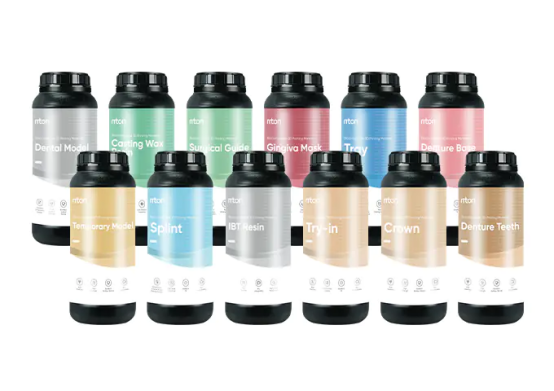
When transitioning to digital dental workflows, equipment naturally receives considerable attention. Even with well‑specified hardware, the final performance of every printed appliance is heavily determined by the liquid photopolymer housed within the resin vat. Choosing high-performance dental-grade resin determines whether a denture try-in maintains its true shape.
Photopolymers intended for patient contact must balance mechanical rigidity, dimensional stability, and chemical inertness. When ultraviolet light strikes liquid resin, photoinitiators trigger rapid cross-linking reactions. How uniformly this transformation occurs dictates the final strength of the clinical appliance.
Substandard materials often warp during post-processing, causing poor intraoral fit and clinical delays. High-quality resins prevent these issues by maintaining tight dimensional tolerances. Consequently, dental labs can deliver precise restorations that seat comfortably without extensive chairside adjustments.
Chemical Engineering for Intraoral Durability
Minimal volumetric shrinkage during polymerization prevents warping along extended arches and prep margins. Meanwhile, high flexural endurance allows full-arch try-ins to withstand functional biting forces. Low water absorption greatly reduces the risk of appliances from swelling, softening, or cracking when exposed to saliva.
Chemical stability prevents degradation caused by fluctuating intraoral temperatures during trial fittings. Formulations engineered specifically for dentistry resist micro-fracturing under stress. This durability gives clinicians absolute confidence during extended diagnostic assessments and functional bite registration procedures.
Additionally, optical stability prevents yellowing caused by ambient room light or curing units. Maintaining consistent color fidelity ensures try-in appliances retain natural aesthetics. Patients benefit from realistic evaluations, while clinicians accurately assess tooth shade compatibility.
The Value of an Experienced Dental Resin Manufacturer
Working with an established dental resin manufacturer guarantees strict raw material quality control and consistent reactivity profiles like Riton. They formulate materials alongside optical engines, tuning photopolymers to specific ultraviolet spectrums for crisp boundaries and complete conversion.
Integrated development prevents common curing defects, such as internal light bleeding or unreacted chemical residues. Standardized batch processing ensures every bottle performs identically, eliminating trial-and-error adjustments. Dental laboratories save substantial time by using predictable material chemistries.
Manufacturer support also extends to certified slicing parameters and exposure profiles. Technicians simply select pre-tested material profiles within their software, avoiding costly print failures. This streamlined integration optimizes resin consumption and maximizes daily hardware productivity.
Dedicated material engineering also ensures long-term shelf stability and consistent viscosity. Stable liquid properties prevent pigment settling inside bottles during storage. As a result, technicians achieve uniform color distribution and mechanical performance throughout every milliliter of resin.
Advanced Prosthodontic Materials: Riton Model TN-1.0 A2
Full-denture try-ins represent one of the most demanding additive applications in modern dentistry. Formulated specifically for removable prosthodontics, Riton Model TN-1.0 A2 delivers realistic Shade A2 aesthetics alongside exceptional structural integrity for accurate clinical trial evaluations.
This specialized material allows clinicians to evaluate occlusion records and tissue fit directly inside the patient’s mouth. By capturing precise anatomical details, it reduces guesswork during trial fittings, ensuring smooth transitions to final permanent prostheses.
Riton Model TN-1.0 A2 features high flexural strength between 72 and 80 MPa, alongside a flexural modulus rating of 1800 to 1900 MPa. This robust mechanical profile supports functional occlusal loads during trial bite evaluations without flexing or cracking.
Mechanical Performance and Biocompatibility Standards
Low surface wear protects occlusal contacts from premature degradation during masticatory testing. Simultaneously, water absorption remains under 1.3 percent to prevent material swelling. Dimensional stability ensures that intraoral trial fittings remain accurate throughout extended clinical assessments.
Compatible with both 385 nm and 405 nm light engines, this resin integrates easily into diverse dental printing systems. Labs can deploy this material across different hardware setups without modifying existing curing equipment or risking inconsistent polymerization results.
Biocompatibility remains non-negotiable for intraoral applications. Generic resins can leave unreacted monomers that leach into saliva, causing localized tissue irritation. Certified medical-grade photopolymers undergo thorough post-curing validation to guarantee complete monomer conversion and total patient safety.
Thorough cleaning protocols combined with standardized post-curing light intensity ensure the removal of uncured surface monomers. This process produces a highly inert surface that helps resist plaque accumulation, offering protection to oral tissues during trial fittings and extended diagnostic use.
Global safety benchmarks including FDA clearance and CE certification constitute valuable regulatory references for dental teams, when such credentials are held by the selected resin material. Using certified materials protects patient health while mitigating legal risks for the practice, establishing a strong foundation for clinical excellence.
Workflow Efficiency and Laboratory Economics
High green-state strength ensures printed parts maintain physical shape right off the build platform, minimizing distortion during washing and post-curing. Technicians can polish try-in appliances quickly to a natural sheen, enhancing patient comfort during fittings.
Reduced finishing time significantly lowers labor costs per unit across high-volume laboratory environments. Technicians focus on complex artistry rather than tedious manual correction. This operational efficiency drastically cuts overall production costs while increasing turnaround speeds.
Furthermore, predictable printing results minimize raw material waste caused by misprints or dimensional remakes. Consistent material behavior ensures that digital CAD designs translate accurately into physical parts on the first attempt, safeguarding laboratory profit margins.
Hardware capabilities provide the optical platform, but material formulation determines clinical reality. Investing in premium dental-grade resin transforms digital CAD designs into reliable physical prostheses that seat accurately, function comfortably, and satisfy demanding clinical standards.
Advanced photopolymer solutions empower modern dental facilities to elevate treatment predictability and optimize overall laboratory efficiency. By combining precise chemical formulations with reliable hardware, laboratories build lasting relationships with clinical partners and drive continuous business growth.
As digital dentistry evolves, material science will continue driving clinical possibilities forward. Partnering with forward-thinking resin developers guarantees access to cutting-edge formulations. Modern practices remain competitive by adopting materials that deliver uncompromised precision and long-term durability.

