
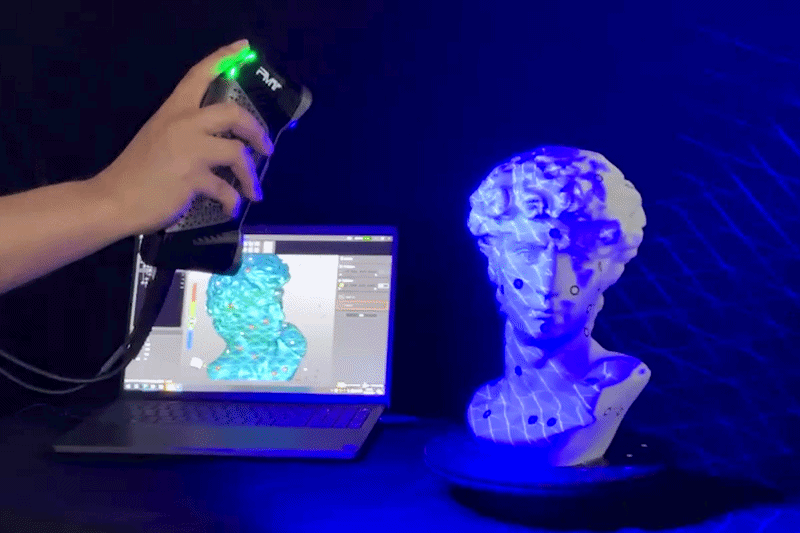
A portable handheld 3D scanner is often selected for its flexibility in industrial measurement, reverse engineering, quality inspection, and product development. However, one common question among businesses is how far these devices can realistically scan while maintaining reliable accuracy. The answer depends on multiple factors, including scanning technology, object size, surface characteristics, working environment, and the scanner’s hardware capabilities.
Understanding the Realistic Range of a Handheld 3D Scanner
The scan range of a handheld 3D scanner does not simply refer to the maximum distance between the device and the target object. In practical applications, it includes the size of the scanning area captured in one pass, the recommended working distance, and the ability to maintain stable data quality during the scanning process.
For industrial users, a realistic scanning range is usually determined by whether the device can collect complete and accurate 3D data efficiently. A scanner may technically capture a large area, but if the point cloud quality decreases or details become unclear, the actual usable range will be limited.
Most handheld 3D scanners are designed for medium-sized components, complex surfaces, and detailed inspection tasks. They provide flexibility that traditional measurement tools cannot easily achieve, especially when objects cannot be moved to a fixed measurement station.
Factors That Influence Portable Handheld 3D Scanner Performance
The performance of a portable handheld 3D scanner depends heavily on its scanning technology. Laser-based systems, structured light systems, and other optical methods each have different strengths in terms of speed, accuracy, and adaptability.
For example, laser scanning solutions can be effective for capturing industrial parts with complicated geometries. However, reflective, transparent, or dark surfaces may require additional preparation to ensure stable data collection.
Object size is another important consideration. Small mechanical components may require high-resolution scanning to capture tiny features, while larger industrial equipment requires a wider scanning field to reduce the number of scanning movements. Therefore, companies should evaluate whether a scanner’s practical scanning area matches their application instead of focusing only on advertised maximum capability.
The working environment also affects results. Lighting conditions, vibration, operator movement, and surface conditions can influence scanning stability. Businesses using scanning equipment for quality control or manufacturing inspection should consider the complete workflow rather than only the theoretical range.
How a Portable Handheld 3D Scanner Supports Large and Complex Workpieces
A portable handheld 3D scanner provides advantages when businesses need to inspect large or irregular components directly at production sites. Instead of transporting heavy parts to a measurement room, operators can bring the scanning equipment to the object, improving efficiency and reducing preparation time.
For large workpieces, scanning speed and data processing capability become increasingly important. A scanner that captures a wider area per pass can reduce the time required to complete a project while maintaining consistent measurement results.
The SMARTSCAN handheld 3D scanner from PMT is designed for applications requiring convenient, non-contact measurement and accurate reproduction of workpiece details. It uses 51 blue cross laser lines to capture a scanning area of up to 700 × 600 mm in a single pass. This wide scanning area helps operators collect surface information efficiently when working with complex industrial components.
With optimized CPU processing and intelligent reconstruction algorithms, SMARTSCAN improves point cloud acquisition and processing efficiency. This allows users to handle larger surfaces and complicated workpieces more effectively during inspection, design verification, and reverse engineering tasks.
Choosing the Right Scan Range for Industrial Applications
When selecting a handheld 3D scanner, companies should consider their typical measurement tasks instead of choosing a device based only on the largest possible scanning range. A suitable scanner should balance coverage, accuracy, portability, and workflow efficiency.
For automotive parts, machinery components, aerospace structures, and manufacturing inspection, a scanner with a practical scanning field can help engineers capture sufficient data without excessive repositioning. Meanwhile, applications involving detailed components may require higher precision and closer scanning capabilities.
A portable handheld 3D scanner should also integrate smoothly with existing inspection processes. Data compatibility, scanning speed, ease of operation, and post-processing efficiency all influence the overall value of the equipment.
Finding the Right Balance Between Range and Accuracy
A larger scanning range does not always mean better performance. In industrial measurement, accuracy and data reliability remain critical factors. A scanner that provides a wide capture area while maintaining stable reconstruction can deliver better results than a device with a larger theoretical range but inconsistent data quality.
The realistic range of a handheld 3D scanner is therefore a combination of technical specifications and practical usability. Businesses should evaluate how efficiently the equipment can complete real projects, from initial data capture to final analysis.
PMT’s SMARTSCAN demonstrates how modern scanning solutions can combine broad scanning coverage with efficient processing. By supporting a scanning area of up to 700 × 600 mm and using advanced laser and reconstruction technologies, it provides a practical option for companies seeking flexible measurement solutions for complex workpieces.
Selecting a Practical Scanning Solution for Future Needs
The realistic scan range of a portable handheld 3D scanner depends on more than distance or coverage size. Industrial users need equipment that delivers reliable data, supports different workpiece sizes, and improves measurement efficiency in real production environments.
As 3D measurement requirements continue to expand, businesses are increasingly looking for scanners that combine portability with professional-level performance. Solutions like PMT SMARTSCAN show how a well-designed handheld 3D scanner can help companies achieve faster inspection, accurate modeling, and more efficient product development processes.

