
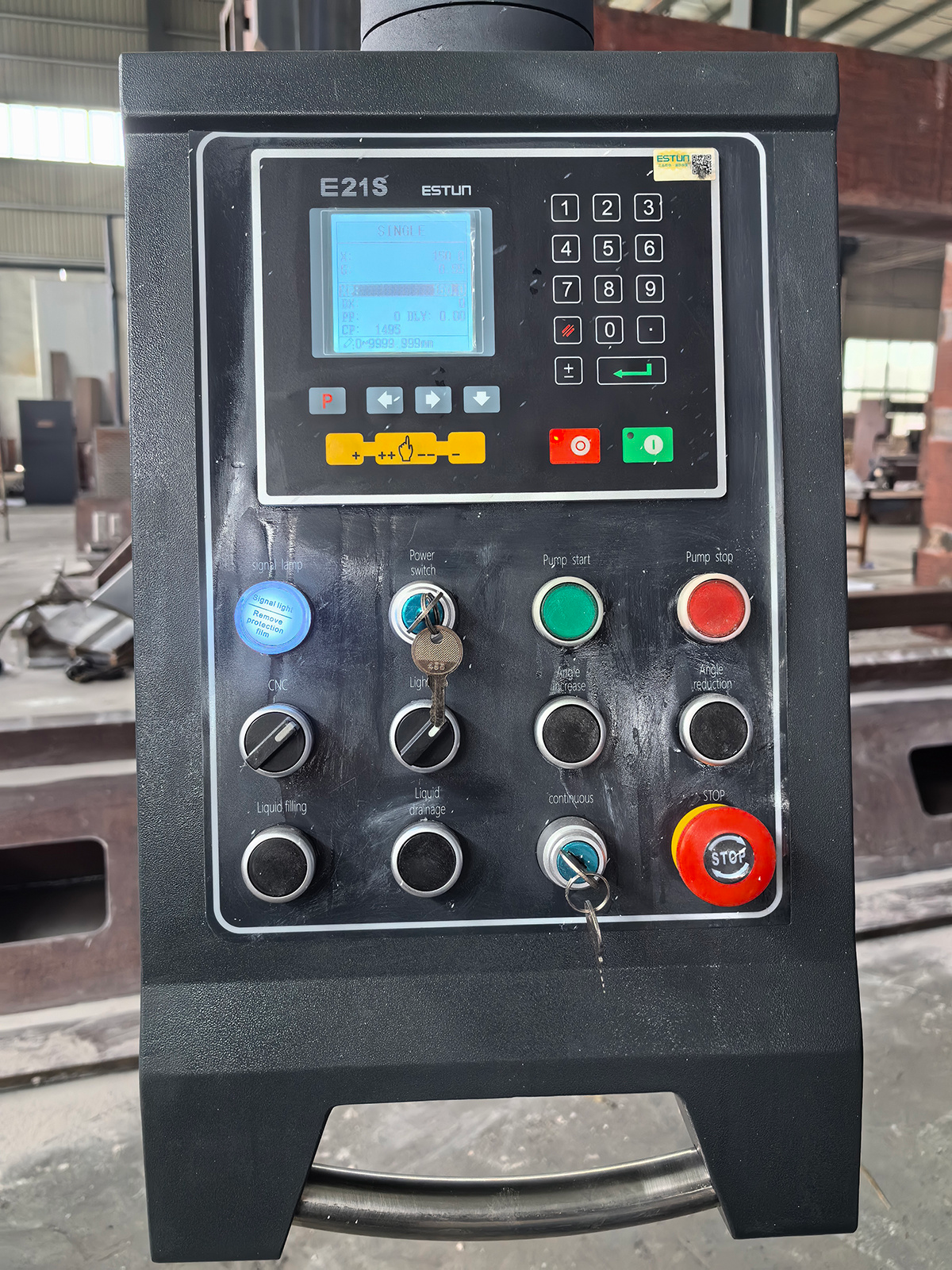
With the material unchanged, different settings can alter strip dimensions, edge condition and the movement needed for a cut. In a CNC guillotine shearing machine, the controller connects a production requirement to selected machine actions. Its contribution becomes clearer when the setting, the action and the effect on the sheet are considered together.
A CNC shearing machine can include functions for positioning, blade-related adjustments and repeated production sequences, depending on the fitted equipment. Each function has a physical job to perform. Understanding those jobs distinguishes control capability from a screen layout and explains why the mechanism available to execute a command remains part of the comparison.
From a Cut Dimension to a Gauge Position
Setting the backgauge establishes a locating reference before the blade moves. The stop sits behind the cutting line, so its position defines the distance against which the sheet is registered. Changing that distance changes the nominal strip width rather than the force available to shear it. The controller can reposition this reference as the sequence progresses through different dimensions.
On a CNC guillotine shearing machine, a position command reaches the plate through the gauge drive and stop arrangement. Repeating a coordinate can simplify the return to a known dimension, while the gauge assembly retains its own travel and loading limits. A programmed value outside the usable movement range cannot create the space needed to register a larger workpiece.
Retraction serves a different purpose from selecting the next strip width. It moves the stop away at the appropriate point in the cutting sequence, giving the material clearance from the gauging face. On a CNC shearing machine, this movement needs coordination with holding and blade movement. It is therefore a sequence function rather than simply another dimension to enter.
Programming the gauge does not by itself load or square the sheet. Where feeding is manual, the operator still presents the material against the intended reference before the holding and cutting actions. Auxiliary supports can make this positioning manageable for a large plate, but they remain part of the machine arrangement rather than a result of entering a coordinate.
Adjustments That Change the Cutting Action
Clearance between the upper and lower blades influences how the sheet separates. As the blades penetrate, the sheet first deforms and then fractures from the regions beside their edges. The gap changes how the fracture paths approach one another through the thickness, affecting the resulting edge and burr formation. A clearance command is useful where the machine has the corresponding adjustment mechanism.
Because the upper cutting edge is inclined, the cut advances progressively across the sheet instead of engaging the whole length at once. Increasing that inclination reduces the length engaged at a given moment but requires more blade movement to complete the same cutting length.
The setting can therefore affect load and the tendency of the separated strip to deform. Its value belongs to the material and cutting task rather than functioning as an isolated speed setting.
Stroke control limits the blade movement needed for the intended cut, so a short cutting task need not always use the same travel as a full-length job. Pressure control concerns the hydraulic action driving the cut. Both functions depend on the valves and mechanical arrangement supplied with the machine. Software alone neither adds rated force nor changes the frame’s capacity.
The QC11K E21S 8×3200 from Colgar has a programmable backgauge. The retract function lets the gauge move away from the sheet during the cutting cycle. Automatic blade adjustments need their own actuators and control channels, so a programmable backgauge alone does not provide them.
The fitted controller determines which other settings the operator can program. Colgar lists E21S and E200PS options for backgauge positioning, workpiece counting, program storage and data recovery. The DAC360 controls shear angle, blade clearance, stroke and hydraulic pressure when the machine has the corresponding mechanisms.
Reusing a Sequence Within the Fitted Configuration
Program storage allows a CNC guillotine shearing machine to recall supported settings and backgauge positions in the order a recurring job requires. For a sequence with several strip widths, the operator can call up the planned positions instead of entering each one again. The recalled program should be checked against the current material and tooling before cutting.
The record should identify the program version alongside the part drawing and the machine on which it ran. This prevents a similarly named program from being used with a different gauge range or cutting sequence.
On a CNC shearing machine, a workpiece counter tracks the quantity completed. Program backup and recovery preserve the setup for later use. A first-piece check still has to confirm strip width and edge condition, because the count cannot reveal a dimensional error or a burr.
The DAC310 option associated with Colgar limits cutting length and displays backgauge position. Those functions let the operator check travel and positioning before storing the job. Changes in plate thickness or grade can still call for different blade settings, even when the program calls for the same strip width.
A stored sequence is ready for repeat production once the operator confirms the current setup and accepts the first cut. It then reduces repeated entry of settings the controller and machine are equipped to execute.

